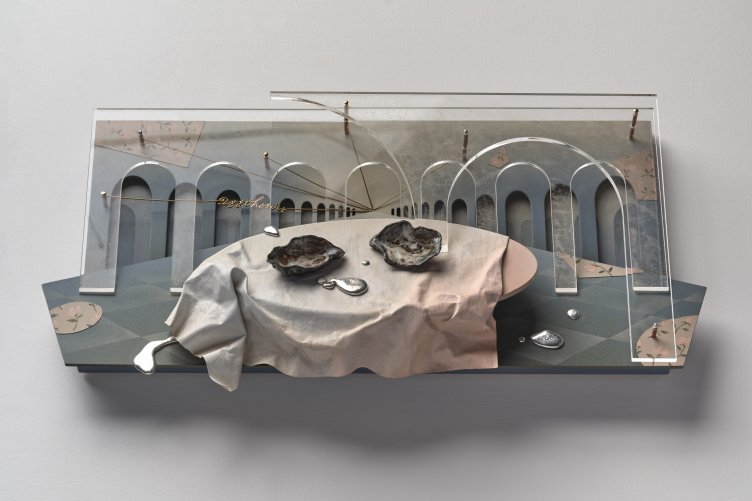
The exhibition focuses on living artists and works produced during the first two decades of the twenty-first century, composing an idiosyncratic collective biography of the period. The exhibition brings together works by around forty women artists living in Latvia, across the Baltic region, and elsewhere in the world, most of them drawn from the Zuzāns Collection. Its premise was inspired by the remarkable number of women artists represented in the collection, which encompasses more than 500 artists and works dating from the early twentieth century to the present.
The exhibition takes its conceptual starting point from British visual culture theorist Irit Rogoff’s 2005 essay Looking Away – Participations in Visual Culture, in which she proposed looking away from artworks as another way of participating in culture. Twenty years later, the exhibition Looking Away develops this idea by inviting artists to shift their attention from the finished work to the conditions in which it was made.
The exhibition’s curator Snejana Krasteva (Bulgaria) together with the co-curator Jevgēnija Hamudajeva realised this approach through individual conversations between the curators and every participating artist. The conversations provide previously missing context for the artworks and open up questions around the financial, personal, and creative environments in which they were made. Rather than imposing a predetermined narrative, the exhibition allows for a wide range of responses, including unexpected and deeply personal ones.
The context of these conversations carries over into the exhibition: each selected artwork is accompanied by contextual layers chosen by the artists, offering a deeper understanding of how it was made. These may include handwritten notes, a scent, a fragment of the studio wall, or a work by a friend – traces that acquire their meaning only when we are willing to look beyond the artwork itself. The exhibition Looking Away does not propose a generalising thesis about women artists in twenty-first-century Latvia. Instead, it creates a space for artists to determine how they represent themselves and invites audiences to look beyond the artwork itself, towards the personal, creative, and social contexts that surround it.
As part of the exhibition, Zuzeum Art Museum will implement an accessibility project aimed at enabling people with visual impairments to explore the exhibition’s artworks through touch and other accessibility solutions.