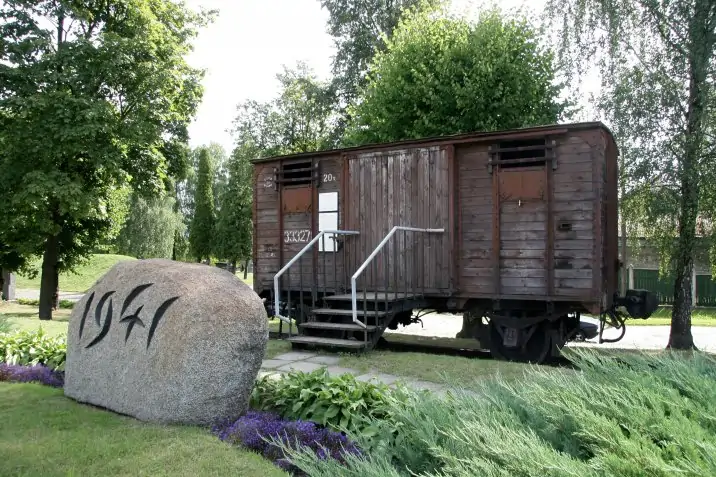
June 14, 1941 was fateful day for more than 15,000 Latvian residents. According to a decision by the Soviet authorities, without any court hearing, these were herded into cattle wagons and taken from the Torņakalns Station to the farthest corners of the Soviet Union, where they were condemned to hunger, frost and death in harsh conditions, or in concentration camps and places of imprisonment.
In memory of these victims of communist terror, a memorial has been created in Torņakalns, the most emotionally impressive element of which is the deportation rail wagon. Looking at the small wagon, it is hard to believe that it was possible to "load" more than 40 people into it. How can you imagine that in such harsh conditions - without proper food, without basic necessities, without anything - people were transported thousands of kilometres.
The memorial stone near the station building was unveiled in 1990, its author is the sculptor Ojārs Feldbergs. The memorial rail wagon was restored according to historical photographs and set-up at the site in 1996. A commemorative memorial opened in 2001 (sculptor - Pauls Jaunzems, architect - Juris Poga) can also be viewed near the wagon. It consists of five broken stone figures, symbolizing "destroyed family hearths and three exiled generations.
Why visit
Torņakalns Station is one of Latvia’s most significant memorial sites, offering visitors an opportunity to reflect on a tragic chapter in the country’s history. It was from this station that thousands of Latvian residents were forcibly deported to remote regions of the Soviet Union in June 1941. Today, the memorial complex preserves the memory of those affected by Soviet repression through symbolic monuments and historical elements.
Historical highlight
On 14 June 1941, more than 15,000 people across Latvia were deported without trial following orders from the Soviet authorities. Families were separated and transported in cattle wagons to labour camps and remote settlements thousands of kilometres away. Many never returned.
The memorial complex beside Torņakalns Station includes a freight wagon similar to those used during the deportations, a memorial stone engraved with the year “1941” and sculptural elements symbolising the lives and families torn apart by exile. Created during the restoration of Latvia’s independence, the memorial stands as a powerful reminder of the human cost of political repression and the importance of preserving historical memory.
How to get there
Torņakalns Station is located in the Torņakalns neighbourhood of Riga on the left bank of the city, just a short journey from the city centre. The site can be reached by regional and suburban trains stopping at Torņakalns Station, as well as by nearby tram and bus routes. Visitors can also walk or cycle from central Riga via the bridges and riverside paths connecting the city centre with the Torņakalns neighbourhood.