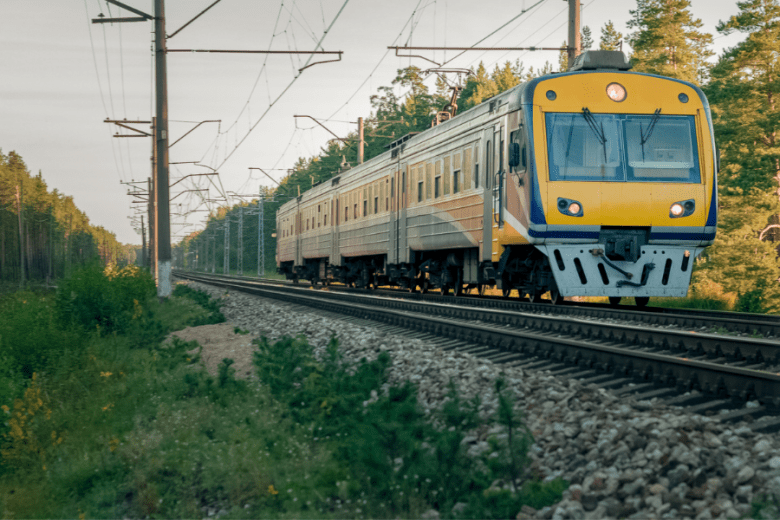
Electric trains are a convenient and affordable way to travel both within Riga and to nearby destinations. They are especially popular for trips to the seaside resort of Jūrmala, offering a quick and scenic journey from the city centre.
Where you can go
Within Riga, electric trains operated by the state-owned operator ViVi, connect several neighbourhoods and outer districts, making them a practical option for longer distances.
For visitors, the most popular route is to Jūrmala, which takes around 30 minutes. The resort town has multiple stations, including Lielupe, Bulduri, Dzintari, Majori and Dubulti. Majori is considered the central stop and is closest to the main beach and promenade.
During warm and sunny days, especially in the summer, additional trains are often added to seaside routes, including services towards Vecāķi.
Ticket prices and options
Train tickets are affordable and vary depending on how you purchase them:
- At ticket offices: approximately €0.90–€1.50 (within city limits)
- Online via the ViVi website or app: around €0.86–€1.43
- On board from the conductor: €1.40–€2.00 (if the ticket office was open at departure station)
There is also an integrated ticket which costs €2 and combines a single ride on trains within Riga city limits with a 90-minute ticket for public transport in Riga (trams, buses and trolleybuses). This ticket can be purchased only via the ViVi website or app.
Travel tips for visitors
- Buy tickets online to save money and avoid queues
- Check the correct station in Jūrmala before travelling - the town has several stops
- Allow extra time during peak summer days when trains can be busy
- Keep your ticket until the end of the journey, as inspections are common
Travelling with bicycles
Bicycles are allowed on trains with an additional baggage ticket. Look for train carriages marked with a bicycle symbol near the door - these are equipped with holders for bikes. This makes it easy to combine train travel with cycling along the coast.
Schedules and more information
Train schedules, routes, ticket types and travel rules are available online via vivi.lv.
Checking the timetable in advance is recommended, especially for evening return trips from the coast.
Why use electric trains in Riga
Electric trains are a practical choice for travellers looking to explore beyond the city centre. They are affordable, frequent and reliable, making them ideal for day trips and longer journeys.
One of the most popular routes is to Jūrmala, which takes around 30 minutes and connects to several beachside stations such as Majori, Dzintari and Bulduri.
Trains are also a great option for avoiding traffic, especially during busy seasons, and they provide a comfortable way to travel while enjoying views of the surrounding landscapes. Bicycles can be taken onboard with an additional ticket, making it easy to combine train travel with outdoor activities.
The electric train network
Electric train travel in Riga dates back to the mid-20th century, when the first electrified railway line connected the city with the seaside resort of Jūrmala in 1950. Over time, the network has expanded to include routes to Jelgava, Skulte, Aizkraukle and other destinations, forming the core of suburban rail transport in Latvia.
Currently there are four electrified train lines running from Riga to nearby cities and all of the lines start at Riga Central Station.
- Tukums – this line has stops in the Riga neighbourhoods of Torņakalns, Zasulauks, Zolitūde and Imanta, as well as the immediate suburb Babīte. The line also passes through the seaside resort town Jūrmala, making this the most popular line during the summer months.
- Skulte - this is another popular route in the summertime as it connects Riga with several seaside towns and resorts northeast of the city, and it also has a stop near the Vecāķi beach, which is the most popular beach within the city’s borders. In addition to that, the line also stops in Riga neighbourhoods of Vecdaugava, Vecmīlgrāvis (stop name Ziemeļblāzma), Mīlgrāvis (stop name Mangaļi), Sarkandaugava, Brasa and Čiekurkalns (stop name Brasa), as well as Grīziņkalns (stop name Zemitāni). The Mangaļi stop is also located a 10-minute walk from the Northern edge of the Mežaparks park, which is a popular destination throughout the year.
- Jelgava – this line connects Riga with Latvia’s 4th largest city Jelgava, as well as the suburban city of Olaine. It also stops in the Riga neighbourhoods of Torņakalns, Bieriņi and Atgāzene.
- Aizkraukle – this line connects Riga with the cities of Aizkraukle, Lielvārde, Ķegums, Ogre, Ikšķile and smaller settlements in between them, as well as the suburban city of Salaspils. It also stops in the Riga neighbourhoods of Dārzciems (stop name Vagonu parks), Ķengarags (stop names Jāņavārti and Daugmale), Šķirotava, Rumbula and Dārziņi.