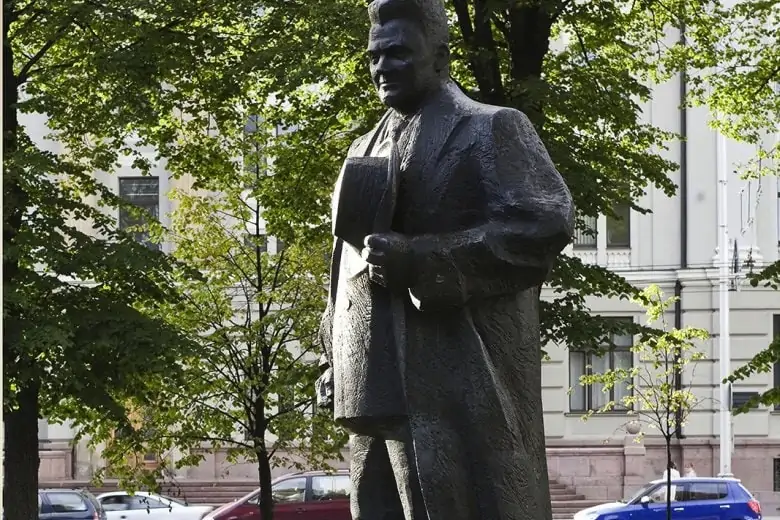
Standing at the intersection of Krišjāņa Valdemāra Street and Raiņa Boulevard, the bronze monument to Kārlis Ulmanis commemorates one of the most influential and controversial figures in Latvia's history. Unveiled in 2003, the statue honours a politician who played a leading role in establishing Latvia's independence but later ruled the country as an authoritarian leader.
Located near Riga's historic centre, the monument offers an opportunity to explore a complex chapter of Latvian history.
Kārlis Ulmanis and the founding of independent Latvia
Kārlis Ulmanis (1877–1942) was one of the key figures behind the establishment of the Latvian state in 1918. As head of the country's first provisional government following the proclamation of independence on 18 November 1918, he helped guide Latvia through its early years of statehood.
Ulmanis served several terms as prime minister and became an influential figure in the country's political and economic development. He was particularly associated with agriculture, rural development and the promotion of Latvian national identity.
From parliamentary democracy to authoritarian rule
Despite his key role in establishing an independent Latvia, Ulmanis later brought an end to its parliamentary democracy.
On 15 May 1934, while serving as prime minister, he organised a coup d'état, dissolved the Saeima (Latvian parliament), banned political parties and established an authoritarian regime.
In 1936, Ulmanis also assumed the office of president, consolidating his control over the government. His rule continued until the Soviet occupation of Latvia in June 1940. Following the occupation, Ulmanis was arrested and deported by Soviet authorities. He died in Soviet custody in 1942.
A legacy that continues to spark debate
Ulmanis remains a complex figure in Latvian history. Some remember him for his contribution to independence, economic development and the strengthening of Latvian national identity. Others emphasise his responsibility for dismantling democratic institutions and restricting political freedoms.
The monument reflects this complicated legacy, inviting visitors to consider both his achievements and the consequences of his political decisions.
Why visit
The monument is a thought-provoking stop for anyone interested in Latvia's independence and 20th-century history. Located close to Riga's Old Town, it offers a chance to discover a political figure whose decisions helped shape the country and whose legacy remains the subject of historical debate.
Historical highlight
The Monument to Kārlis Ulmanis was unveiled in 2003, funded through private donations and presented to the city by the Riga Latvian Society and the National Culture Development Fund. Erected more than a decade after Latvia regained independence, the monument commemorates a prominent figure in the country's interwar history.
How to get there
The Monument to Kārlis Ulmanis stands at the intersection of Krišjāņa Valdemāra iela and Raiņa bulvāris, close to Riga's Old Town and the Latvian National Theatre.
It is easily reached on foot from the most central landmarks and is also accessible by public transport serving the surrounding streets.