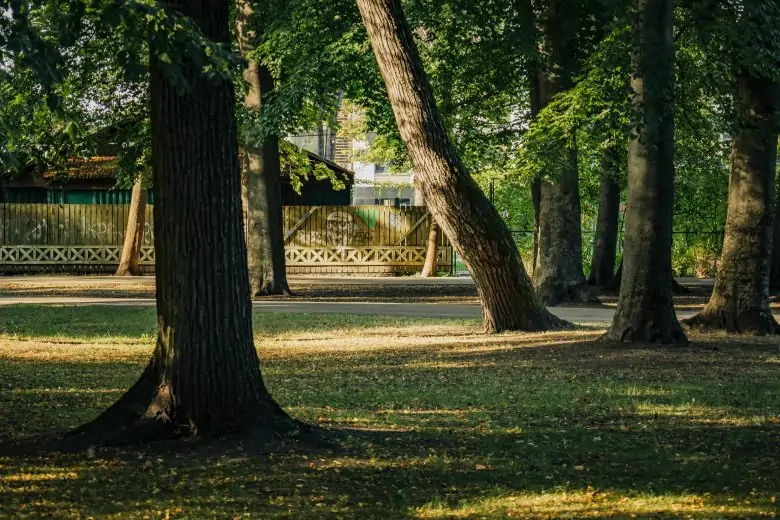
Covering 7.6 hectares, Viestura dārzs is the oldest public park in Riga. Established in 1711 by order of Russian Emperor Peter the Great, the park was originally created as part of the grounds surrounding his planned summer residence.
Today, visitors can still see the descendants of the elm trees planted during that era, adding a living connection to the park’s more than 300-year history. Located near the Daugava River and Riga’s Quiet Centre district, the park offers a peaceful setting for walks, picnics and outdoor recreation away from the busiest tourist areas.
The birthplace of Latvia’s Song Festival tradition
Viestura dārzs holds a special place in Latvia’s cultural history as the site of the first All-Latvian Song and Dance Festival in 1873.
During the second half of the 19th century, the park became an important venue for public gatherings, theatre performances and concerts. An open-air stage was built here in the 1860s, laying the foundations for what would become one of Latvia’s most important cultural traditions.
Today, visitors can see a sculptural ensemble dedicated to the centenary of the Song and Dance Festival, celebrating a tradition now recognised by UNESCO as Intangible Cultural Heritage.
A long tradition of sport and recreation
Viestura dārzs has long been associated with active leisure and was home to some of Riga’s earliest sports clubs. From 1883 onwards, the park featured a skating rink and sledding hill in winter, while tennis courts attracted players during the warmer months. This sporting tradition continues today, and visitors can still enjoy tennis in the park. The sound of tennis balls and the sight of the historic Alexander Gate create an atmosphere reminiscent of classic European garden parks.
The Alexander gate
One of the park’s most distinctive features is the Alexander Gate, also known as the Triumph Arch, which was relocated to Viestura dārzs in 1936. Visitors can also enjoy landscaped pathways, mature trees, ponds frequented by ducks and quiet corners ideal for relaxation. The park’s proximity to the Art Nouveau district and the Daugava waterfront makes it an easy addition to a day of sightseeing in Riga.
Whether you are interested in history, culture, architecture or simply looking for a peaceful place to unwind, Viestura dārzs offers a unique blend of heritage and nature in the heart of the city.
Why visit
Viestura dārzs is an ideal place for a leisurely walk, a picnic or a break between sightseeing stops. Visitors can stroll along tree-lined paths, relax by the ponds, watch ducks and admire historic monuments hidden among the greenery.
The park also features tennis courts and open spaces for recreation, continuing a sporting tradition that dates back more than a century. Its location near the Art Nouveau district and the Daugava riverside makes it easy to combine with other attractions in central Riga.
Historical highlight
One of the most distinctive landmarks in Viestura dārzs is the Alexander Gate, also known as the Triumph Arch. Built in 1817, the arch commemorates the victory of the Russian Empire over Napoleon’s army and honours the visit of Tsar Alexander I to Riga.
The monument was relocated to Viestura dārzs in 1936 to preserve it during urban redevelopment. Today, it is the only surviving triumphal arch in Riga and stands as an important example of early 19th-century Classicist architecture.
Surrounded by the park’s historic greenery, the Alexander Gate connects visitors to Riga’s layered past and serves as a reminder of the city’s changing political and cultural landscape over the centuries.
How to get there
Viestura dārzs is located in Riga’s Quiet Centre district, between Hanzas iela and Eksporta iela, approximately a 20-minute walk from Old Town. The park is easily accessible by tram, bus and trolleybus, with several stops nearby on Eksporta iela and Hanzas iela.
Visitors can also reach the park on foot or by bicycle while exploring the Art Nouveau district and the Daugava waterfront.