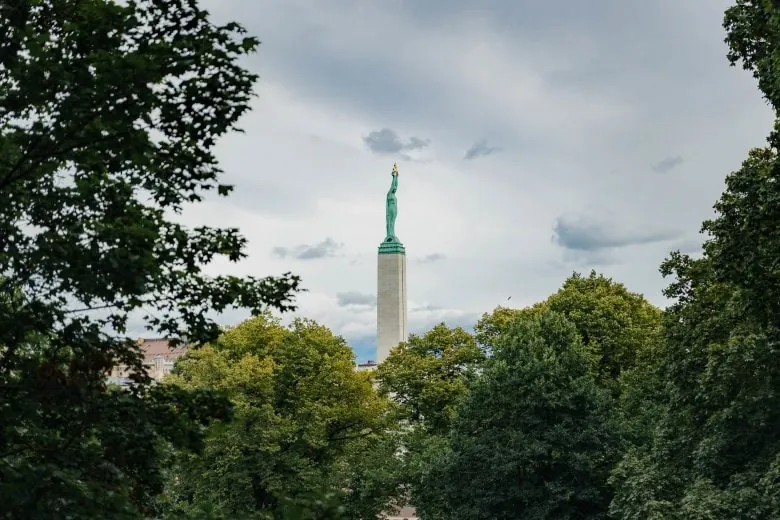
The Freedom Monument has been Riga's central landmark for almost a century. This 42.7 m tall granite and copper work of art is a symbol of the Latvian nation's striving for freedom and independence.
The woman on top of the monument is holding up three golden stars, which represent Latvia's historical regions of Kurzeme, Vidzeme, and Latgale. The motto "For the Fatherland and Freedom" is inscribed upon the base. It was unveiled on 18 November 1935 and financed entirely from public donations.
Design and construction
The Freedom Monument was erected according to the design by the outstanding Latvian sculptor Kārlis Zāle (1888–1942); he was also artist for the Memorial Ensemble at the Brethren Cemetery. Zāle's idea was implemented by architect Ernests Štālbergs (1883–1958); the construction lasted for four years.
Symbolism and sculpture groups
The Freedom Monument is an architectural representation of the idea of freedom — the large-scale sculptures, arranged on several levels, depict significant events and personalities in the Latvian history.
Fifty six sculptures are arranged in thirteen groups on four levels. The base level of the monument symbolises the nation's work ethic, spiritual strength, and striving for independency. The front of the monument features two travertine reliefs "Latvian Riflemen" and "Latvian People: the Singers"; the other groups depict the Latvian basic values — "Work", "Guards of the Fatherland", "Mother — Family Guard", and "Scholars". On the sides, the travertine panels bear reference to the Russian Revolution of 1905 and Latvian War of Independence. The middle block symbolises the nation's ideals and striving for freedom — "Latvia" is ready to defend the Motherland, "Chain Breakers" try to break free from their chains, "Lāčplēsis" (an epic Latvian folk hero) encourages to fight against evil powers, while "Vaidelotis" (a Baltic pagan priest) symbolises spiritual strength.
The top of the marble obelisk is crowned by a woman hewed in copper. She is holding up three golden stars, which represent the unity of Latvia's historical regions.
The monument through history
The Freedom Monument was built during Latvia’s first period of independence. From the moment it was unveiled, it became a powerful symbol of national identity and unity, representing the country’s right to self-determination and its cultural resilience.
During the Soviet occupation, any gathering at the Freedom Monument was strictly forbidden. But with the Reawakening, people gathered here to honour the establishment of the Republic of Latvia, War of Independence, occupation and repression. After Latvia's independence was restored in 1991, the honour guard was again deployed at the foot of the monument.
Guard of honour
A guard of honour stands at the base of the Freedom Monument, symbolizing respect for Latvia’s independence and those who fought to defend it. The guards are part of the Latvian National Armed Forces, and their presence highlights the monument’s role as a national memorial. They are located at the foot of the monument every day between 10 and 16, with the changing of the guard is performed every hour and conducted with formal, precise movements - quiet, dignified, and meaningful. It is both a ceremonial tradition and a living symbol of Latvia’s restored statehood.
Why visit
Visiting the Freedom Monument offers more than just a view of an iconic landmark - it provides a sense of the country’s identity and spirit. The monument stands at the crossroads of Riga’s historic centre and the city’s main boulevard, surrounded by parks, cafés, and cultural sites. It’s a natural starting point for exploring Old Town, the Art Nouveau district, and the riverfront. Whether you're interested in history, photography, or simply getting a feel for Riga, stopping here is essential to understanding the story and heart of Latvia.
Historical highlight
The Freedom Monument was built during Latvia’s first independent republic to honour those who secured the nation’s freedom. Over time, the monument’s role shifted - from a proud celebration of independence to a silent symbol of resistance during Soviet rule, and then back to a central emblem of Latvian sovereignty after independence was restored. Today, it stands not only as a memorial, but as a visible reminder of resilience and the enduring importance of freedom in Latvian culture.
How to get there
The Freedom Monument is located in the very centre of Riga, between Old Town and the city’s main boulevards. It’s easily reached on foot from most major attractions. Many tram and bus lines stop nearby, and taxis can drop you directly at the monument. Once there, the area is pedestrian-friendly, making it easy to explore the surroundings.