In Latvian folklore, Saule travels across the celestial hill, Laima determines each person’s destiny, and Jumis watches over the grain fields. These deities are closely involved in human life - in everyday work, seasonal celebrations and hopes for the future. Their stories have survived mainly through folk songs, legends, fairy tales and folk beliefs, rather than a single collection of sacred texts. Discovering Latvian mythology offers a fresh perspective on the crafts found at Riga’s artisan markets: patterned mittens, woven belts, silver jewellery and traditional rooftop ornaments. Here, age-old patterns meet more recent interpretations and the imagination of each maker.

A World of Deities and Symbols
Meet the Deities of Latvian Mythology
Dievs - keeper of the world’s order. In dainas, traditional Latvian folk songs, he rides over the hill, enters the farmyard and takes part in people’s lives. He is associated with justice and order, although Latvian deities do not form a strict hierarchy under a single ruler.
Saule - giver of light and life. The sun goddess is one of the most vivid figures in Latvian mythology. In folk songs, she travels across the sky, cares for people and is affectionately called Saulīte. Latvia’s seasonal festivals follow her journey, particularly the summer and winter solstices.
Laima - goddess of fate. She is present at life’s defining moments: birth, marriage and the beginning of a new chapter. People turn to Laima to ask for good fortune or to question why their lives have taken a particular course.
Māra - guardian of mothers and children. In folklore, she cares for women in childbirth, newborn babies and women more broadly. She is also associated with the wellbeing of cows and an abundance of milk. Her character brings together beliefs from different periods, including the influence of the Christian Virgin Mary.
Pērkons - the heavenly blacksmith. The thunder god makes the skies rumble, pursues dark forces and brings the rain on which fertile fields depend. He embodies both the power of a storm and the promise of a good harvest.
Mēness - keeper of the lunar rhythm. Many folk beliefs link the moon’s waxing and waning to sowing, planting and other tasks. In folk songs, Mēness takes part in celestial weddings and sometimes appears as a warrior.
Jumis - bringer of harvest and abundance. His presence was recognised in two joined ears of grain and other double fruits. At the end of the harvest, people symbolically “caught Jumis” to keep fertility on the farm for the following year. You may spot the Jumis motif at the roof peaks of traditional buildings.
The Mothers of nature and the afterlife. In Latvian folklore, the forest, sea, wind and many other aspects of the world have their own mother figure. Meža māte watches over forest life, Vēja māte governs the winds, and Veļu māte welcomes the dead. These figures reveal a world in which nature plays an active part in human affairs.
What Do Traditional Latvian Symbols Mean?
Stars, zigzags and branching patterns appear throughout Latvian woven belts, mittens, blankets and jewellery. Today, many have familiar names and symbolic meanings.
Saules zīme - sun symbol Light, life and the cycle of the year
Auseklis - morning star The morning star, light and protection
Māras krusts - Māra’s cross Blessings for the home and prosperity
Jumis Fertility - harvest and abundance
Pērkona krusts or ugunskrusts - thunder cross or fire cross Strength, movement and protection
Laimas slotiņa - Laima’s broom Good fortune and symbolically sweeping away misfortune
Zalkša zīme - grass snake symbol Wisdom and blessings for the home
These patterns have no single “dictionary” of meanings that has remained unchanged through the centuries. Many familiar names and interpretations became established in the 20th century, particularly during the interwar period. A pair of patterned mittens or a pendant can therefore be appreciated both as craftsmanship and as a symbol given meaning by its maker and wearer. At a market, it is worth asking: what is the story behind this design?
Trees Where Nature Meets Myth
In Latvian folk songs, oak and linden trees seem almost as alive as people. The oak is often associated with strength and masculinity, the linden with a woman’s life, and the birch with spring’s awakening. The World Tree holds a special place in Latvian mythology, connecting the heavens, the human world and the realm of the dead.
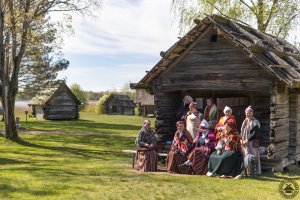
Walking among old trees or exploring the traditional farmsteads at the Ethnographic Open-Air Museum of Latvia makes it easier to imagine the setting in which these beliefs developed. Nature provided food and shelter, shaped the rhythm of work and held mysteries that people sought to understand.
Fate, Love and Connections with Ancestors
Latvian dainas often describe human lives through images from nature: a young woman is a linden tree or a rose, while a young man is an oak. People may ask Laima about their destiny, seek her help or even reproach her for a life