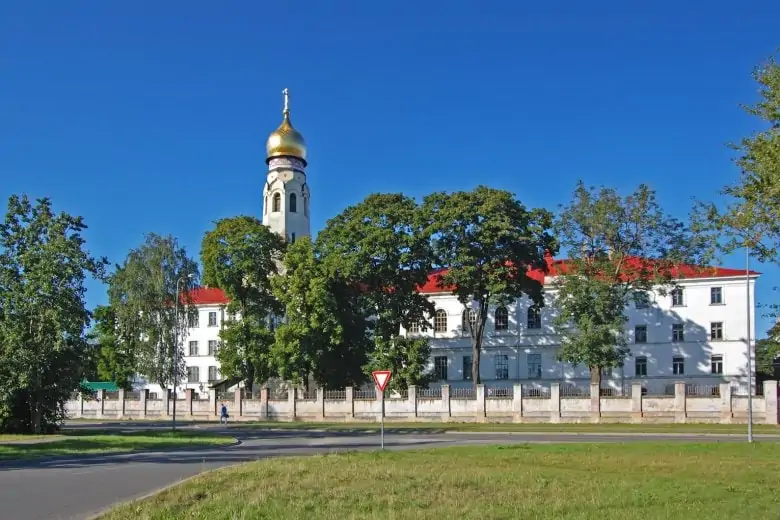
The Grebenshchikov Old Believers’ Church is one of the most important religious sites in Riga and the largest Old Believers’ parish in the world, with around 25,000 members. It remains an active place of worship where services are held according to centuries-old traditions, offering visitors a rare glimpse into a distinct branch of Orthodox Christianity.
History and development
The origins of the church date back to 1760, when a simple wooden prayer house was built on the banks of the Daugava River. Known as the Moscow House of Prayer on Dvina, it served the Old Believers community in Riga.
By the end of the 18th century, the building was rebuilt in stone, reflecting the growing importance of the parish. In 1826, the church was named after Alexei Petrovich Grebenshchikov, a merchant and supporter of the Old Believers.
Architecture and interior
The church combines Byzantine architectural forms with later additions, including a slender tower built in 1905–1906 and topped with a gilded onion dome in Art Nouveau style. This blend of styles makes the building visually distinctive.
Inside, the church features a large prayer hall with a richly decorated iconostasis, as well as several ceremonial spaces and rooms for clergy. The interior houses an impressive collection of icons, books and manuscripts dating from the 15th to the 19th centuries, reflecting the depth of its spiritual and cultural heritage.
Visitor experience
Visitors are welcome to observe the church from the outside and, when appropriate, step inside to experience its peaceful and traditional atmosphere. Modest dress and respectful behaviour are recommended, especially during services. For those interested in religious history, architecture or cultural diversity, this church offers a unique perspective on Riga’s multicultural heritage beyond the more commonly visited landmarks.
Why visit
The Grebenshchikov Old Believers’ House of Prayer is one of the most unique religious sites in Riga, offering insight into a lesser-known but deeply rooted spiritual tradition. Visitors are drawn by its distinctive architecture, including the golden onion dome, as well as its peaceful and authentic atmosphere. It provides a different perspective on Riga’s multicultural heritage beyond the more familiar churches in the Old Town.
Historical highlight
In 1826, the church was named after Alexei Petrovich Grebenshchikov, a merchant and supporter of the community. The building continued to evolve, gaining its current appearance in the late 19th and early 20th centuries, including the addition of a slender tower with a gilded dome.
How to get there
The house of prayer is located at Mazā Krasta iela 73, slightly outside the centre of Riga. It can be reached in about 10-15 minutes by car or public transport from the city centre.