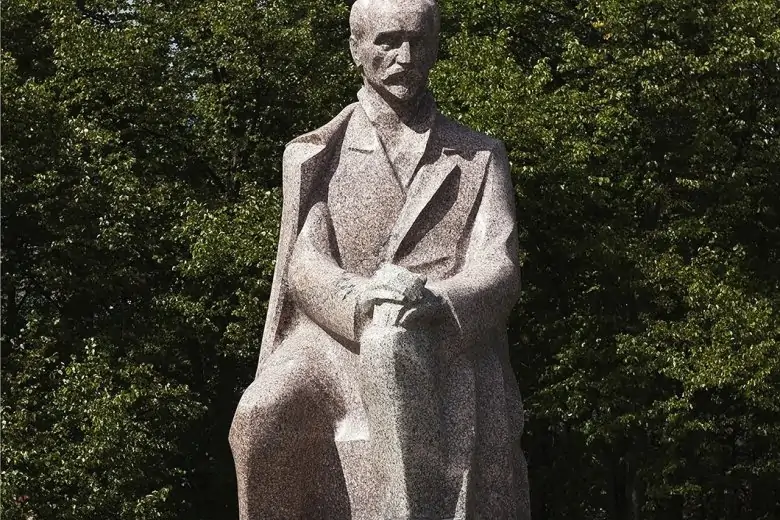
In the heart of Riga, surrounded by the greenery of Esplanāde Park, stands a monument to one of Latvia's most celebrated literary figures, Rainis (1865–1929). Born Jānis Pliekšāns, he was a poet, playwright, translator and politician whose work helped shape Latvian literature and national identity.
The poet who shaped Latvian culture
Rainis was much more than a writer. His poetry and plays explored freedom, social justice, personal responsibility and the future of the Latvian nation. He also introduced Latvian readers to major works of European literature through translations of Goethe's Faust, Shakespeare's King Lear, Schiller's Mary Stuart and Byron's Cain.
An active participant in the revolutionary movement of 1905, Rainis was forced into exile in Switzerland following the revolution's defeat. Together with his wife, the renowned poet and playwright Aspazija, he settled in Castagnola, near Lugano. During this period, he wrote some of his best-known plays, including The Golden Horse (Zelta zirgs), Indulis and Ārija and I Played and Danced (Spēlēju, dancoju).
After returning to Latvia in 1920, Rainis continued his political and cultural activities. He served as a member of the Constitutional Assembly and the Saeima, became Minister of Education and played a significant role in the development of Latvian theatre.
Poetry Days: Celebrating Rainis's legacy
Today, his legacy lives on through literature, theatre and the annual Poetry Days (Dzejas dienas) celebrations. Held around his birthday on 11 September, these events bring writers, students and poetry enthusiasts together, with the monument serving as one of Riga's traditional gathering places.
Why visit
The monument is an impressive granite sculpture depicting Rainis seated in a thoughtful pose. Set among the trees of Esplanāde Park, it offers a peaceful place to pause while exploring central Riga. It's also a meaningful stop for anyone interested in Latvian culture, literature and the people who helped shape the country's national identity.
Historical highlight
The Monument to Rainis was unveiled on 11 September 1965, marking the centenary of the poet's birth. Designed by sculptor Kārlis Zemdega and completed by sculptors Aivars Gulbis and Laimonis Blumbergs, the impressive granite sculpture has become one of Riga's best-known literary monuments.
Interestingly, the monument was erected during the Soviet occupation of Latvia. Soviet authorities celebrated Rainis for his socialist beliefs and involvement in the revolutionary movement of 1905, while largely overlooking his support for Latvian independence and parliamentary democracy. His legacy was selectively presented to fit Soviet ideology, allowing him to be honoured as an important cultural figure even under Soviet rule. Today, the monument represents Rainis's broader legacy as a poet, playwright, political thinker and influential voice in Latvia's cultural and national history.
How to get there
The Monument to Rainis is located in Esplanāde Park, in central Riga, close to the Latvian National Museum of Art and the Nativity of Christ Cathedral.
It is easily reached on foot from Riga Old Town and the Freedom Monument. Several public transport routes also serve the surrounding streets, including Brīvības Boulevard and Kalpaka Boulevard.