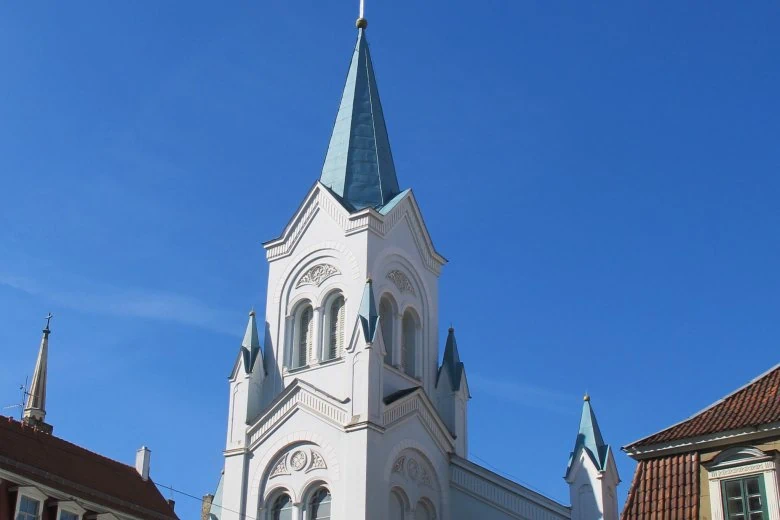
The white-and-blue Our Lady of Sorrows Church was the first newly built stone Catholic church in Riga (1785) after the Reformation had reached Livonia, a historic region once encompassing present-day Latvia and Estonia.
The idea of constructing the church was especially supported by Austrian Emperor Joseph II. The Classicism-style building was dedicated to Our Lady of Sorrows symbolising the oppressed Catholic religion in Terra Mariana.
From 1859 to 1860, the church was rebuilt according to the design of Riga architect Johann Felsko – the presbytery was moved to the opposite south-western or Daugava side, the sacristy was added, and the façade of the church was redesigned in a Pseudo-Romanesque style. In 1895, an eight-sided Neo-Renaissance baptistery was built on the west side of the church, designed by Wilhelm Bockslaff.
Why visit
Our Lady of Sorrows Church is one of the oldest Roman Catholic churches in Riga and a calm, reflective stop close to the Old Town. Its pale blue-and-white exterior stands out among nearby historic buildings, while the interior offers a quiet atmosphere for contemplation or a short cultural break during sightseeing. Visitors come to admire its simple elegance, learn about Catholic history in Latvia, or attend regular services that still take place today.
Historical highlight
The church was originally built in 1785, marking the return of Catholic worship in Riga after centuries of restrictions. During the 19th century it was rebuilt and expanded, gaining new architectural details and an octagonal baptistery. Over time it has remained an important spiritual centre for the city’s Catholic community and a visible symbol of religious continuity in Latvia’s capital.
How to get there
The church stands on Pils Street near Riga Castle and Castle Square, making it easy to reach on foot from the Old Town riverfront area. Numerous buses and trams stop in the surrounding central streets, and from there it is just a short walk to the entrance.