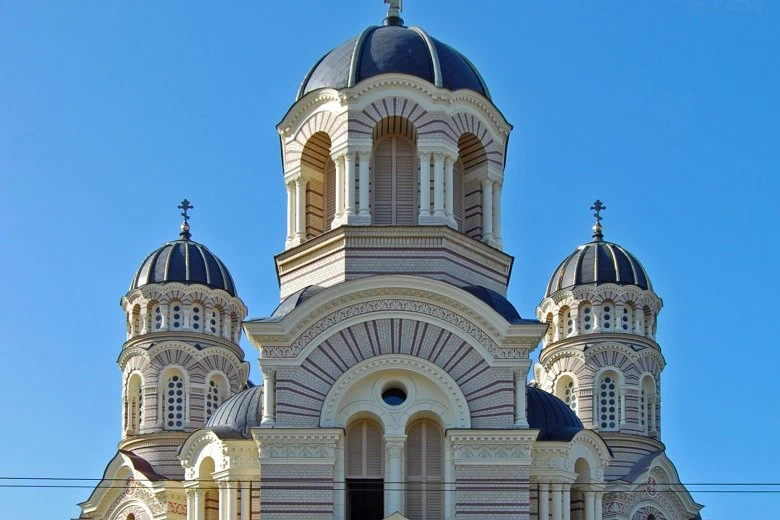
The cathedral is the largest Orthodox church in Riga. After surviving the Soviet era as a planetarium, it has been restored and has once again become a sacred building where Orthodox services are held regularly.
Construction and architectural style
The cathedral was inaugurated in 1884. The Neo-Byzantine style building was the most expensive edifice of that time in Riga, its interior was very luxurious and of high artistic quality. The cathedral was renowned for its outstanding collection of ancient icons, Byzantine-style frescoes with ancient Christian ornaments, as well as three iconostases painted by the brightest pedagogues of the St Petersburg Academy of Arts and the famous Russian painter Vasily Vereshchagin. The cathedral survived the Soviet era, when it housed a planetarium and a café.
Transformation during the Soviet period
During the Soviet occupation, the cathedral lost its religious function and was repurposed to fit ideological needs. Its sacred interior was stripped of many original elements, icons were removed, and the space was redesigned to house a planetarium, complete with projection equipment and exhibitions about astronomy and space exploration - a typical Soviet attempt to replace religious culture with scientific education. Part of the building was also converted into a café, making the cathedral an everyday leisure venue rather than a place of worship. Despite these changes, the building’s core structure remained intact, allowing for restoration decades later.
Restoration and renewal
The cathedral’s restoration began in the 1990s and it was reopened in 2000, once again becoming an iconic sacred building. The cathedral's central iconostasis consists of 33 icons painted in the tradition of the schools of Andrei Rublev and Theophanes the Greek. The church has also received back 12 of its former icons from the collections of the Latvian National Museum of Art and Rundāle Palace.
Why visit
The Nativity of Christ Cathedral is one of Riga’s most striking landmarks, known for its golden domes, intricate Neo-Byzantine architecture, and richly restored interior. Visitors can admire its ornate iconostases and vibrant frescoes - quite different from the city’s Gothic and Art Nouveau surroundings. Whether you’re interested in architecture, sacred art, or cultural history, the cathedral offers a memorable and visually captivating experience right in the heart of Riga.
Historical highlight
Consecrated in 1884 as the most ambitious Orthodox church in the Baltic region, the cathedral reflects the grandeur of the Russian Empire’s architectural tradition. Its history took an unusual turn during the Soviet era, when it was converted into a planetarium and café, stripping the building of its religious purpose.
How to get there
The cathedral is located in Esplanāde Park, just a short walk from Riga’s Old Town and the Art Nouveau district. It’s easily reached on foot from most central areas or by public transport - several buses and trolleybuses stop nearby along Brīvības Boulevard.