Just a short walk from Riga's Dome Square, St Saviour's Anglican Church is a distinctive piece of British heritage in the heart of Riga Old Town. Built between 1857 and 1859, the church stands close to the Daugava River and has a fascinating history connecting British merchants, sailors, religious life and the city's cultural scene.
Today, the church remains an active place of worship and community gathering, welcoming visitors interested in its architecture, history and English-language services.
English-language services and concerts
St. Saviour’s Anglican Church is the only Church of England parish in Latvia, thus being one of the rare places in Riga where visitors and residents can attend Christian worship in English.
Sunday services have traditionally been held at 11:00, welcoming both members of the local congregation and English-speaking visitors. The church has also hosted Wednesday lunchtime concerts at 13:00, offering an opportunity to enjoy live music in a historic setting, with donations welcomed. As service times and concert schedules may change, it is advisable to check the church's current programme before visiting.
Why visit
The church offers a different perspective on Riga's religious and architectural heritage. While the city's historic centre is best known for its Lutheran and Catholic churches, this Anglican church tells the story of Riga's longstanding connections with Britain.
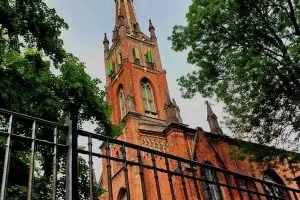
Designed by architect Johann Daniel Felsko, the building is an attractive example of 19th-century Gothic Revival architecture. Its red-brick exterior, pointed arches and elegant details make it a distinctive landmark among the historic buildings of Old Town.
The church is also worth visiting for its cultural and community role. Over the years, it has served not only as a place of worship but also as a venue for concerts, exhibitions and gatherings, reflecting its continuing importance in Riga's social life.
Historical highlight
The story of St Saviour's Anglican Church begins long before the present building was constructed. During the early 19th century, British merchants and sailors were a familiar presence in Riga, an important trading city on the Baltic Sea.
In 1806, British businessmen established the British Poor Fund to assist British subjects in need, support an Anglican clergyman and eventually build a church for the community.
An Anglican congregation was founded in 1822, and the foundation stone of St Saviour's was laid in 1857 on the site of the former Pauls Bastion. According to a well-known story, a shipload of soil was brought from Britain so that the church could be built on British ground. Building materials, including bricks, were also supplied from Britain. The church was dedicated on 26 July 1859, with regular services beginning later that year.
Its history took a different turn during the Soviet period. Following the Soviet occupation in 1940, the church ceased to function as an Anglican place of worship. In 1973, the building became home to the Riga Polytechnic Institute's Student Club. During this period, it was restored and used as a cultural venue for concerts, exhibitions and dances.
After Latvia regained independence in 1991, religious life returned to St Saviour's. An English-speaking congregation was re-established, and the church once again became a place for worship, although it still occasionally hosts concerts and other events.
How to get there
St Saviour's Anglican Church is located at Anglikāņu iela 2, near the Daugava River in Riga Old Town.
The easiest way to reach the church is on foot. From Dome Square, it is only a few minutes' walk towards the river. The church is also within walking distance of Riga Castle, the Three Brothers and other historic Old Town landmarks. If arriving by public transport, use a stop near the Old Town and continue on foot.